
Landing Page Optimization Tips to Boost Sales
Driving traffic to a landing page is expensive.
Whether you're running Google Ads, Meta campaigns, or organic SEO, every visitor costs time or money. But here's the real question:
Is your landing page converting that traffic into sales?
If not, you don't need more traffic.
You need better landing page optimization.
Landing page optimization (LPO) is the process of improving page elements to increase conversions whether that's purchases, signups or bookings.
Strong optimization builds on solid UI/UX conversion rate principles explained here: How Good UI/UX Can Double Your Website Conversion Rate
In this guide, you'll learn proven, practical landing page optimization tips that can significantly boost your sales in 2026.
What Is Landing Page Optimization?
A landing page is a focused page designed around one goal.
Unlike a homepage, it:
- Targets a specific audience
- Matches a specific campaign
- Removes distractions
- Encourages one primary action
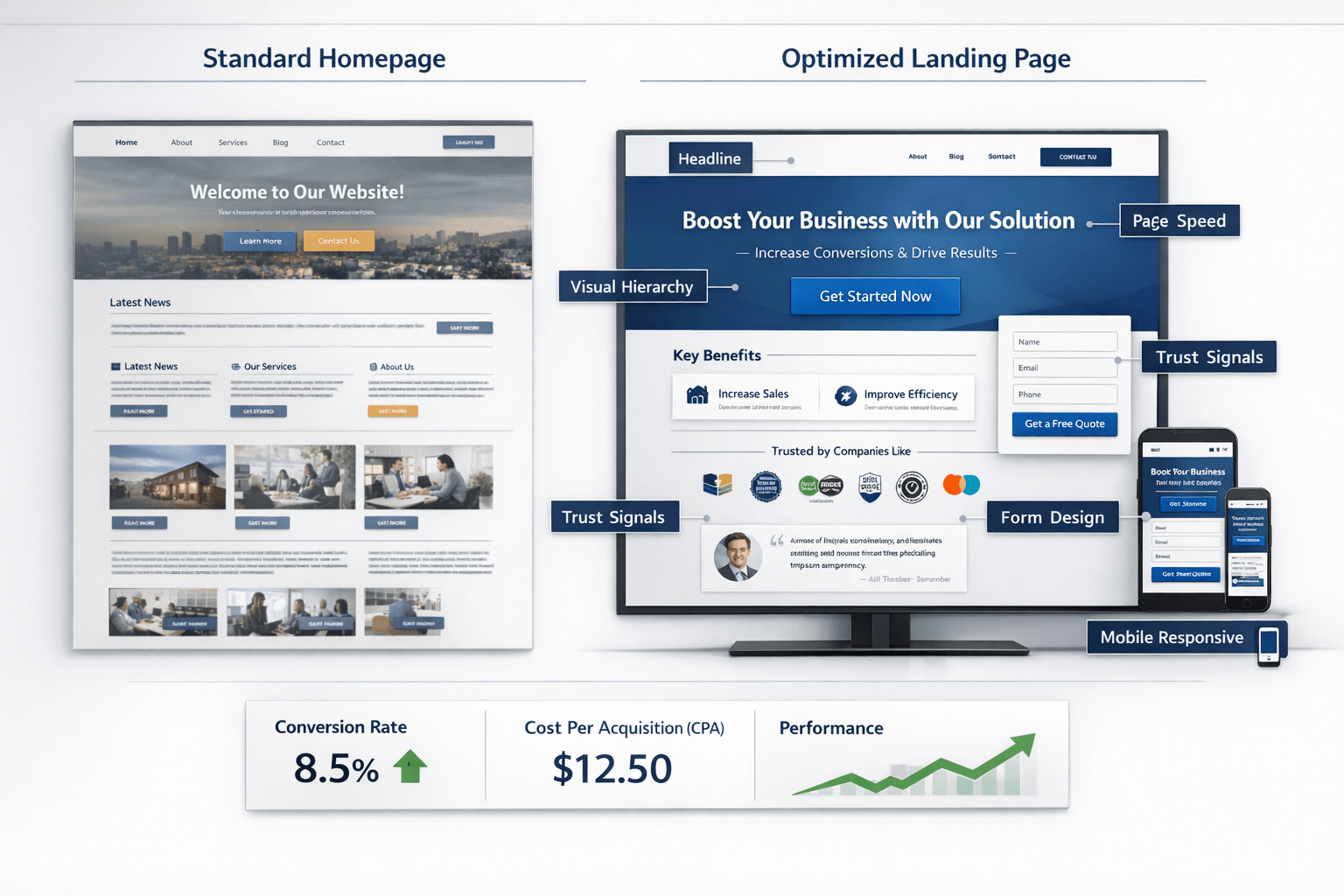
Landing Page Optimization (LPO) improves:
- Headlines
- CTAs
- Page speed
- Visual hierarchy
- Trust signals
- Form design
- Mobile responsiveness
The result? Higher conversion rates and lower cost per acquisition.
Understanding Conversion Goals Before Optimizing
Before optimizing anything, define your goal.
Macro Conversions:
- Product purchases
- Service bookings
- Consultation requests
Micro Conversions:
- Email signups
- Free downloads
- Webinar registrations
Clear goal alignment ensures every design decision supports revenue.
The Psychology Behind High-Converting Landing Pages
Conversion is psychological.
Research from Nielsen Norman Group highlights how usability directly impacts trust and decision-making.
UX research on user attention and behavior
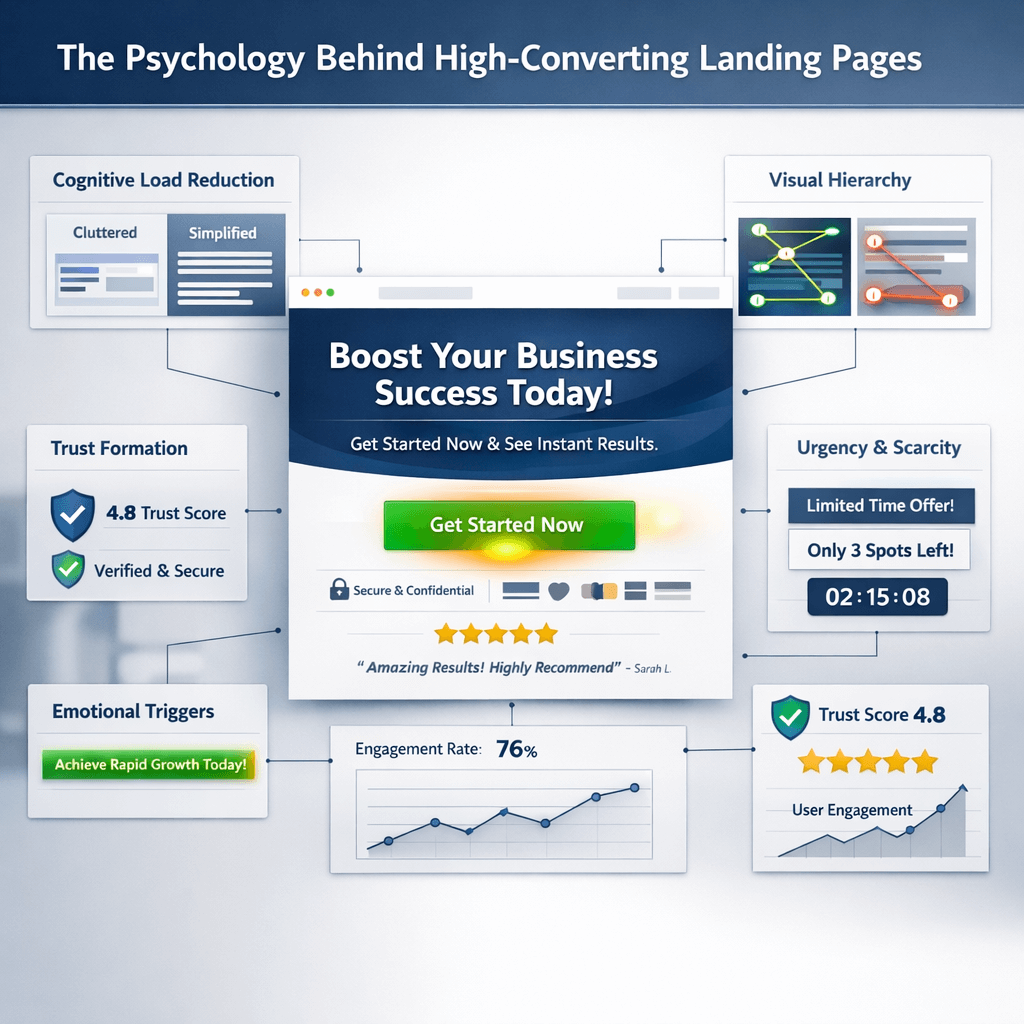
Here are the psychological drivers behind successful landing pages:
1. Cognitive Load Reduction
Too much information overwhelms visitors. Simplicity increases action.
2. Visual Hierarchy
Users scan in predictable patterns. Clear layout guides attention to CTAs.
3. Trust Formation
Visitors decide within seconds whether they trust your page.
4. Emotional Triggers
Benefits outperform features. People buy outcomes, not specifications.
5. Urgency & Scarcity
Limited-time offers increase conversion probability.
Good landing page optimization reduces friction and builds confidence.
1. Craft a Powerful, Benefit-Driven Headline
Your headline determines whether visitors stay or leave.
A high-converting headline:
- Addresses a pain point
- Highlights a clear benefit
- Is simple and direct
- Avoids clever but vague language
Formula example:
“Increase Your Sales by 30% With Data-Driven Landing Page Optimization.”
Test variations regularly. Even small headline tweaks can increase conversions dramatically.
2. Optimize Above-the-Fold Content
Above-the-fold is prime real estate.
Visitors should immediately see:
- A strong headline
- A supporting subheading
- A visible CTA
- A relevant visual
Avoid clutter. Don't overwhelm visitors with multiple options.
If you're aligning design with evolving trends, consider modern visual clarity strategies discussed here: How Good UI/UX Can Double Your Website Conversion Rate
3. Design High-Converting CTAs
Your CTA is the action trigger.
Best practices:
- Use action-driven language (Get Started, Book My Call, Start Free Trial)
- Make it visually distinct
- Place it strategically throughout the page
- Avoid generic text like “Submit”
A strong CTA reduces hesitation and increases click-through rates.
4. Use Persuasive Social Proof
Visitors want reassurance.
Add:
- Testimonials
- Client logos
- Case studies
- Reviews
- Results statistics
If users see others succeeding, they're more likely to act.
You can showcase real client projects and design work.
Social proof strengthens credibility and reduces skepticism.
5. Reduce Form Friction
Forms are often the biggest drop-off point.
Optimize by:
- Asking only essential questions
- Using multi-step forms
- Enabling autofill
- Adding trust statements (“We respect your privacy”)
- Clear error messaging
The shorter and simpler your form, the higher the completion rate.
6. Improve Page Speed & Technical Performance
Page speed directly impacts revenue.
According to Google Web.dev, slower websites significantly increase bounce rates.
Optimize by:
- Compressing images
- Reducing scripts
- Using optimized hosting
- Monitoring Core Web Vitals
- Implementing lazy loading
Even a 1-second delay can reduce conversions by up to 7%.
Core Web Vitals performance guidelines
7. Design Mobile-First Landing Pages
Mobile traffic dominates most industries.
Mobile optimization includes:
- Thumb-friendly buttons
- Readable font sizes
- Vertical content flow
- Simplified checkout process
- Fast load speed
A desktop-only mindset hurts modern conversion rates.
8. Personalization & Dynamic Content
Personalization increases relevance.
Examples:
- Location-based messaging
- Returning visitor offers
- Personalized product recommendations
- Behavior-triggered CTAs
Dynamic experiences increase engagement and conversion probability.
9. Create Clear Visual Hierarchy
Guide the user's eye.
Use:
- Large, bold headlines
- Supporting subtext
- Strategic white space
- Contrast colors for CTAs
- Logical section breaks
Users should intuitively know where to look next.
10. Remove Navigation Distractions
Landing pages are not websites they are focused conversion tools.
Minimize:
- Full navigation menus
- Unnecessary footer links
- External distractions
The fewer exit points, the higher the conversion rate.
11. Use Urgency & Scarcity Strategically
Urgency increases action.
Examples:
- “Limited Time Offer”
- Countdown timers
- Limited stock notices
But use ethically. Fake urgency damages trust long-term.
12. Optimize Visuals & Media
Visuals must support your offer.
Best practices:
- Use real images instead of generic stock
- Show product in action
- Include explainer videos
- Add trust badges
Visual clarity improves comprehension and trust.
13. A/B Testing Framework
Optimization is ongoing.
Test:
- Headlines
- CTA color & wording
- Layout variations
- Form length
- Visual positioning
Platforms like HubSpot provide extensive research on conversion rate optimization research and case studies.
Never assume, test everything.
14. Track the Right Metrics
Monitor:
- Conversion rate
- Bounce rate
- Time on page
- Scroll depth
- Cost per acquisition (CPA)
- Funnel drop-offs
Data-driven decisions outperform guesswork.
Real-World Example: Before & After Optimization
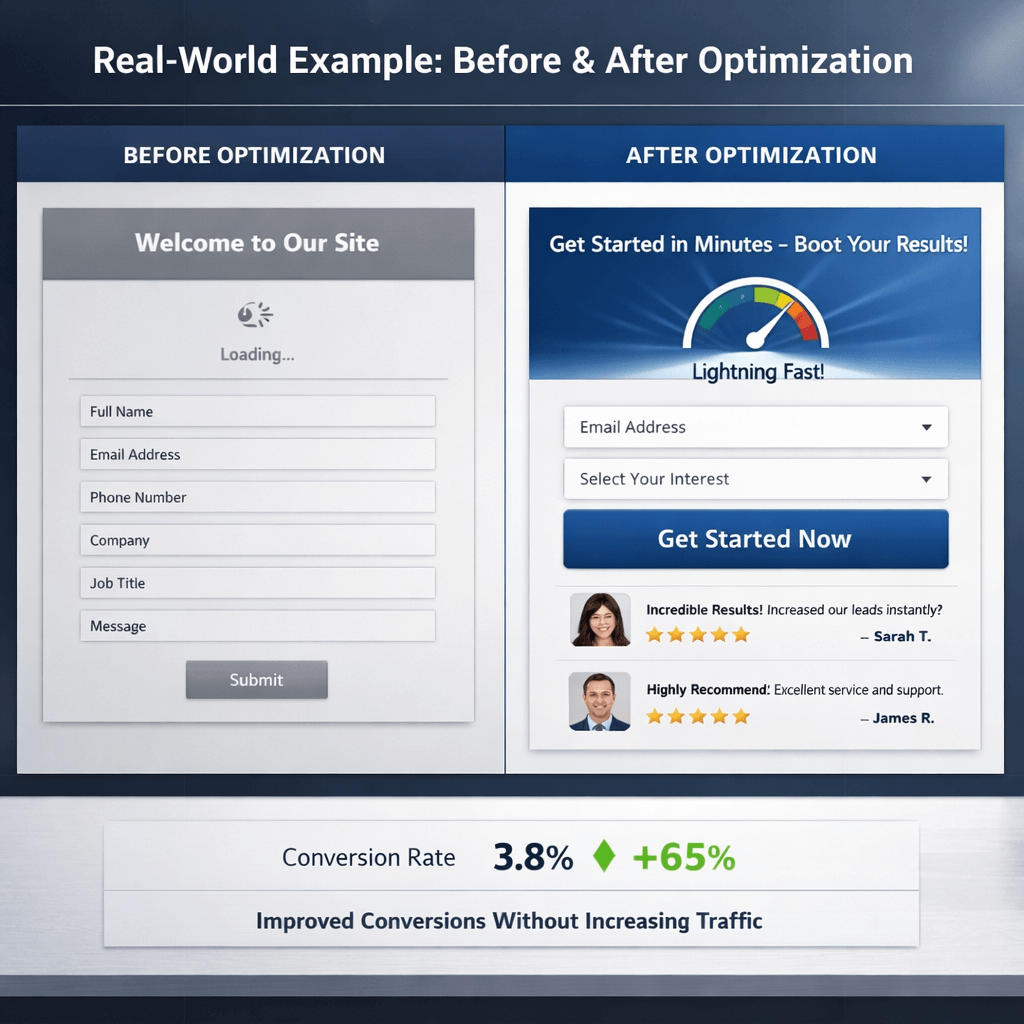
Before:
- Weak headline
- Slow load time
- Long form
- No testimonials
- Confusing CTA
After:
- Clear benefit-driven headline
- Faster performance
- Shortened form
- Added testimonials
- Prominent CTA
Result:
Conversion rate improved significantly without increasing traffic.
If you'd like to improve your landing page performance today, you can request a consultation.
Final Thoughts
Landing page optimization isn't about redesigning everything.
It's about:
- Clarity
- Focus
- Trust
- Speed
- Testing
Small improvements compound into major revenue growth.
If you're investing in ads or SEO but not optimizing your landing page, you're leaving money on the table.
Optimized landing pages don't just boost conversions they maximize ROI.


